
Strategic Market Education: How Markets Actually Move (Order Flow + Psychology + Capital Protection)
Most traders don’t lose because they lack information—they lose because they don’t recognize patterns. In NIFTY 50 and Bank Nifty, the market rewards structure and punishes emotion: late entries, panic exits, revenge trades, and “indicator overload.” This guide fixes that. You’ll learn an institutional-style approach to order flow behavior, psychological traps, trend exhaustion, and a capital protection framework you can repeat daily. Education is not information. It is pattern recognition.
Table of Contents
- What strategic market education really means
- Order flow behavior: the hidden logic of price
- Psychological traps: why good traders sabotage themselves
- Trend exhaustion: how to spot a move losing fuel
- Capital protection framework: survive, then compound
- Daily playbook for NIFTY 50: checklist + journal prompts
- Experience section: what I learned by reviewing many charts
- EEAT boost: tables, links, and real-world references
- FAQ

Outcome 1: You stop trading headlines
You learn how price behaves around liquidity and participation—not news-driven panic.
Outcome 2: You recognize traps early
FOMO, false breakouts, and stop-hunts become visible patterns—so you trade fewer but better setups.
Outcome 3: You protect capital
Risk limits, sizing rules, and stop placement become automatic—not emotional decisions.
Outcome 4: You build repeatable skill
Education becomes pattern recognition: you see the same structures repeating across sessions.
What Strategic Market Education Really Means (And Why Most Traders Miss It)
Most traders think education means: “learn indicators,” “watch YouTube,” “follow tips,” or “collect strategies.” That’s not education—that’s information. Strategic market education is different: it trains your ability to read market intent, recognize repeating behavior, and execute with discipline.
Why does this matter? Because markets are adaptive. The same indicator can behave differently in different environments. A moving average can support price in an uptrend, become meaningless in chop, and fail violently in volatility expansion. Strategic education teaches you to first identify the environment—then decide the tool.
The 4 pillars of strategic market education
- Order flow behavior: why price moves where it moves (liquidity + participation)
- Psychological market behavior: how crowds create predictable traps
- Trend exhaustion: how to detect when a move is losing fuel
- Capital protection: rules that prevent emotional damage and allow compounding
The rest of this article breaks down each pillar with actionable models, checklists, and a daily playbook designed specifically for NIFTY 50 / Bank Nifty traders who want clarity, not noise.
Strategic Market Education (Visual Concept)
Strategic market education showing order flow analysis, psychological market behavior, trend exhaustion and capital protection framework on professional trading screens.
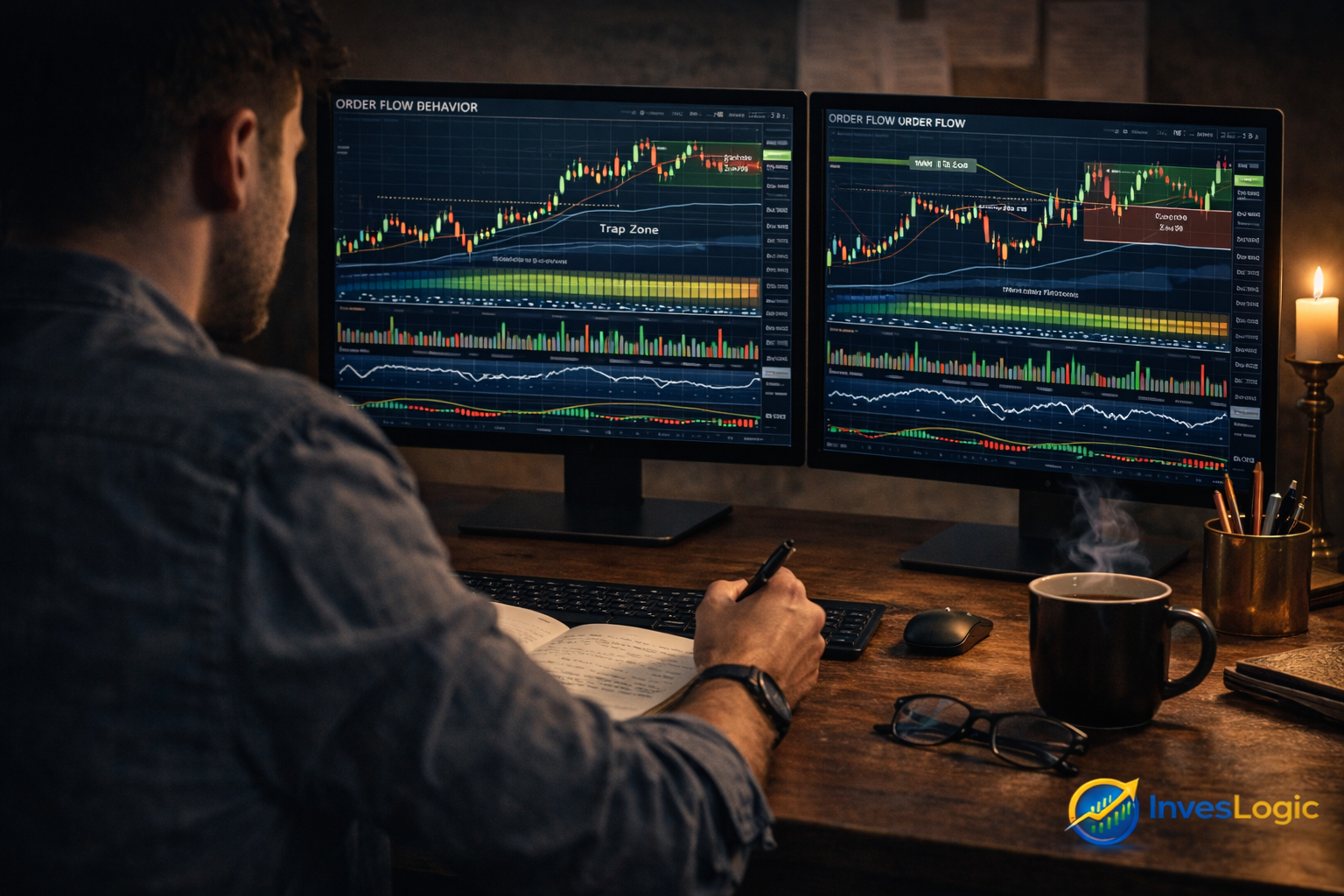
Order Flow Behavior: The Hidden Logic Behind Price Moves
“Order flow” does not require complex tools. At its simplest, it means understanding how buying and selling pressure interacts with liquidity (where orders cluster) and participation (how strongly the market is committing to direction). In index markets like NIFTY 50, price often moves in a way that appears “random” to retail traders—until you view it through the lens of liquidity.
Order flow in plain English
- Liquidity: where many orders are likely sitting (stops, breakouts, pending orders)
- Participation: how aggressively price follows through after breaking a level
- Acceptance vs rejection: whether price stays above/below a level or snaps back
When you see a sudden spike and reversal, most retail traders say “manipulation.” Often it’s simply a liquidity sweep: price goes where orders are, fills them, then moves in the direction supported by participation.
The 5 most common liquidity magnets in NIFTY 50
- Previous day high/low (PDH/PDL): watched by intraday traders
- Equal highs/lows: obvious double top/bottom stop clusters
- Round numbers: psychological order concentration (e.g., 22,000 / 23,000)
- Recent swing points: where many traders anchor their bias
- Breakout levels: where late entries pile in, creating trap risk
Acceptance vs rejection (how to read intent)
A level is not important because you drew it. It becomes important when price shows acceptance or rejection. Acceptance means price breaks and holds; rejection means price pokes and returns. Institutions wait for this proof.
| Behavior | What it often means | What to do |
|---|---|---|
| Break + strong close + retest holds | Acceptance / participation | Look for continuation setup (breakout + retest) |
| Break + wick + immediate snap back | Rejection / sweep | Wait for reclaim confirmation; avoid chasing |
| Multiple tests with no progress | Supply/demand absorption | Reduce size; wait for clean break or step aside |
| Expanding candles after level breaks | Momentum expansion | Size down (volatility ↑) and trade only clean triggers |
Once you start reading acceptance and rejection, you will stop taking trades that look good only on indicators. You begin to trade where the market is actually committing.
Practical drill (to build order flow skill)
- Pick one instrument (NIFTY 50) and one window (first 90 minutes).
- Mark PDH/PDL and equal highs/lows before market opens.
- During the session, note where price “sweeps and returns.”
- Screenshot 5 examples and write: acceptance or rejection?
- Repeat daily for 10 sessions—your pattern recognition will sharpen.
Psychological Market Behavior: Why Crowds Create Predictable Traps
Markets are made of people. Even when algorithms execute trades, humans design them—and humans carry bias. That’s why psychological traps repeat: FOMO entries, panic exits, revenge trading, and overconfidence after a win. Strategic market education teaches you to recognize these traps inside the chart itself.
The 6 most destructive psychological traps (and the fix)
Trap 1: FOMO breakout chase
Fix: Retest rule. If it breaks and doesn’t retest, skip. Opportunity repeats; bad habits compound.
Trap 2: Revenge trading
Fix: Daily max loss + mandatory break. You don’t trade to feel better; you trade when rules align.
Trap 3: Overtrading chop
Fix: Label unclear structure as range. Trade only extremes or confirmed breakout + retest.
Trap 4: Moving stop-loss
Fix: Stop at invalidation. If you move it, you are trading hope—not structure.
Trap 5: Confirmation bias
Fix: Ask “what would invalidate my view?” If you can’t answer, reduce size or don’t trade.
Trap 6: Overconfidence after wins
Fix: Keep position sizing consistent. Big wins often arrive right before big mistakes.
Why “education” beats “motivation”
Motivation fades. Education builds structure in your decision-making. The fastest way to improve psychology is to remove unnecessary choices: fewer trades, clearer triggers, and hard risk limits. If you want psychological control, stop relying on willpower and start relying on systems.
Trend Exhaustion: How to Spot a Move Losing Fuel (Before It Traps You)
Trend exhaustion is not “the market must reverse.” It’s the market showing signs that continuation is getting harder. Many traders keep buying late in an uptrend or shorting late in a downtrend because they confuse momentum with inevitability. Strategic market education teaches you to look for exhaustion signals and demand confirmation.
What trend exhaustion looks like (common signals)
- Reduced follow-through: price breaks a level but fails to continue strongly
- Repeated failures: multiple attempts to make new highs/lows that stall
- Liquidity sweep with weak continuation: stop-hunt then no strong directional expansion
- Change of character (CHOCH): structure shift on a lower timeframe
- Volatility mismatch: big candles at the end of a move with no progress
How to trade exhaustion safely (without guessing)
- Mark the nearest liquidity pool above/below price (equal highs/lows, PDH/PDL).
- Wait for a sweep and reclaim or a clean structure shift (CHOCH).
- Confirm with acceptance/rejection behavior at key levels.
- Use conservative targets first; tighten risk after proof appears.
The goal is not to catch the exact top or bottom. The goal is to avoid being the “last buyer” or “last seller” who gets trapped when the market rotates.
Capital Protection Framework: Survive, Then Compound
Capital protection is the difference between short-term excitement and long-term results. Institutions survive because they treat risk as a system: limits, sizing, stops, and review. Retail traders often do the opposite: they trade bigger after losses, remove stops, and overtrade in chop.
The InvesLogic capital protection stack (simple and strict)
| Rule | What it prevents | Simple implementation |
|---|---|---|
| Daily max loss | Revenge trading spiral | Stop trading after reaching your predefined loss limit |
| Volatility-based sizing | Blow-ups on volatile days | If stop distance increases, reduce position size |
| Stops at invalidation | Random stop-outs & emotional widening | Stop goes beyond the structure that proves you wrong |
| Max trades per session | Overtrading chop | 2–4 quality trades, then stop |
| Post-trade journal | Repeating the same mistake | One-line reason for entry/exit + screenshot |
Stop placement: the most misunderstood skill
Many traders place stops at “comfortable” distances. Markets don’t care about comfort. Stops should be placed at invalidation—where your trade idea is objectively wrong. This reduces the probability of random stop-outs. If you can’t find a clean invalidation point, the setup is unclear. Skip it.
Risk-reward (a professional view)
Risk-reward is not a magic number. It must align with structure. A 1:3 target is meaningless if it sits inside heavy resistance and has low probability. A clean 1:2 with structure support and strong follow-through can be far more profitable over time. Professionals trade probability, not fantasy targets.
Daily NIFTY 50 Education Playbook: Checklist + Journal Prompts
If you want strategic education to translate into performance, you need a routine. The routine below is designed to build pattern recognition quickly—without requiring complex tools.
Pre-market (10–15 minutes)
- Mark PDH/PDL, previous close, and the nearest equal highs/lows.
- Write the environment: trend or range. If unclear, assume range.
- Mark 2 likely liquidity magnets above and below price.
- Set daily max loss and max trades (protect mental capital).
First 45 minutes (observation window)
- Observe volatility: expanding or contracting?
- Watch for liquidity sweeps and reclaims at your zones.
- Do not take impulsive entries—wait for acceptance or rejection proof.
Execution window (when rules align)
- Trade only when: location + structure + one confirmation align.
- Stop at invalidation; size by stop distance.
- Take partials or trail only after first target hits—no micromanaging.
Post-market (5 minutes)
- Journal: “I entered because ___, I exited because ___.”
- Save screenshots of 1 best trade + 1 mistake trade for review.
- Write one rule to reinforce tomorrow (keep it simple).
Experience Section (EEAT Boost): What I Learned Reviewing Many NIFTY Sessions
Here’s the kind of “experience” section Google values because it adds real insight beyond generic advice. While building frameworks and reviewing many NIFTY 50 sessions, one pattern kept repeating: most losses came from entries taken at the worst location—right before liquidity sweeps or inside choppy ranges.
Three observations that improved results the fastest
- Location beats indicator: a “perfect” RSI signal fails if you take it in the middle of nowhere.
- Chop is expensive: when structure is unclear, doing nothing is a profitable skill.
- Risk rules fix psychology: daily max loss and max trades reduce emotional spirals immediately.
This is why InvesLogic emphasizes education as pattern recognition: the same traps repeat. When you can identify them early, your trading becomes calmer, cleaner, and more consistent.
References + Structured Learning Links (EEAT)
Internal links (InvesLogic)
External authority links
For official market and regulatory context, refer to:
FAQ
What is Strategic Market Education in trading?
Strategic Market Education means learning repeatable market patterns—order flow behavior, psychological traps, trend exhaustion signals, and capital protection rules—so you can make decisions with structure instead of emotion.
Is order flow analysis useful for NIFTY 50 and Bank Nifty?
Yes. Order flow thinking helps you understand liquidity zones, stop clusters, and participation shifts—especially around PDH/PDL, equal highs/lows, and breakout/retest areas.
How do I identify trend exhaustion before a reversal?
Trend exhaustion often shows as weak follow-through, repeated failure to make new highs/lows, liquidity sweeps with weak continuation, and a change of character on lower timeframes. Confirmation matters more than prediction.
What is the best capital protection framework for intraday traders?
Use daily max loss, volatility-based position sizing, stops at invalidation points, a maximum number of trades, and a post-trade journal. This reduces emotional damage and improves consistency.
Do I need many indicators to trade professionally?
No. Professional trading is mostly context + execution. Keep tools minimal and focus on structure, liquidity, volatility, and risk rules.
Is this article financial advice?
No. This content is for educational purposes only. Trading involves risk. Always do your own research and consult a qualified professional if needed.
What is Strategic Market Education in trading?
Strategic Market Education is learning repeatable market patterns—order flow, psychology, trend exhaustion, and capital protection—so you trade with structure, not emotion.
Is order flow analysis useful for NIFTY 50 and Bank Nifty?
Yes. It helps identify liquidity zones, stop clusters, and participation shifts—especially around PDH/PDL and equal highs/lows.
How do I identify trend exhaustion before a reversal?
Look for weak follow-through, repeated failures, liquidity sweeps with no continuation, and a clear structure shift (CHOCH) on lower timeframes.
What is a capital protection framework for intraday traders?
Daily max loss, volatility-based sizing, stops at invalidation, limited trades per day, and a post-trade journal.
Do I need many indicators to trade professionally?
No. Most pros use minimal tools: structure + liquidity + one confirmation, and focus more on execution and risk.
Is this article financial advice?
No. It is educational content only. Trading involves risk. Do your own research and consult a professional if needed.
Strategic Market Education
Order Flow
Trading Psychology
Trend Exhaustion
Risk Management
Capital Protection
NIFTY 50
Bank Nifty
Liquidity Zones
Market Structure